
What Is a First Aid Needs Assessment?
The Health and Safety (First-Aid) Regulations 1981 say every employer must provide first aid equipment, facilities and people that are “adequate and appropriate in the circumstances”. They don’t say what that means for you, and HSE says it can’t either: you know your work best. A first aid needs assessment is how you work it out.
HSE’s checklist asks about the type of work, the hazards and how likely they are to cause harm, the size of the workforce, work patterns, holiday and other absences of first aid staff, and your accident history. It also suggests thinking about lone and travelling workers, how far you are from emergency services, shared sites, visitors and mental health support. You don’t have to write it down, but it’s the simplest way to show an inspector how you decided.
The assessment sits alongside your general risk assessments, which are covered in our health and safety training. These rules apply in England, Wales and Scotland; in Northern Ireland, check HSENI’s guidance.
Our free template below follows HSE’s own checklist from its guidance book L74, with a first aid kit checklist and check log built in.
Free template
First Aid Needs Assessment and Kit Checklist
A free, editable first aid needs assessment for UK workplaces, built on HSE's L74 checklist, with HSE's suggested numbers of first aiders, a record of the first aid cover you decide on, a first aid kit checklist with check dates and a review log.
Preview
How to use this assessment
- The Health and Safety (First-Aid) Regulations 1981 require every employer to provide first aid equipment, facilities and people that are adequate and appropriate in the circumstances (regulation 3). This assessment is how you decide what that means for your workplace. The regulations cover England, Wales and Scotland; in Northern Ireland, check HSENI's guidance.
- Have your risk assessments and your accident book or first aid records to hand. Answer each question in section 2, then use HSE's suggested numbers table as a starting point, not a rule.
- Do a separate assessment for each site, and think about parts of a site with different hazards (for example a workshop and an office) separately.
- Record what you decide in sections 3 and 4. HSE says you don't have to write your findings down, but a written record shows how you decided on your first aid arrangements.
- Tell every employee what the arrangements are, including where the kit is and who the first aiders or appointed persons are (regulation 4). Section 5 helps you do that.
- Check each first aid kit regularly and restock it soon after use, using the kit checklist in section 6. Many items, particularly sterile ones, have expiry dates.
- If you decide you need trained first aiders, you are responsible for choosing a competent training provider. HSE's free guide GEIS3, Selecting a first-aid training provider, sets out what to check.
- Review the assessment when anything changes: new work, more staff, a first aider leaving, or an accident or illness your cover didn't handle well. Record it in section 7.
HSE's suggested numbers of first aid personnel
From HSE's guidance L74, Appendix 3. These are suggestions only. HSE says there are no hard and fast rules on exact numbers: adjust them for your answers in section 2, and make sure cover is available at all times people are at work.
| Degree of hazard in your work | Number of employees | Suggested first aid personnel |
|---|---|---|
| Low hazard (for example offices, shops, libraries) | Fewer than 25 | At least 1 appointed person |
| Low hazard | 25 to 50 | At least 1 first aider trained in emergency first aid at work (EFAW) |
| Low hazard | More than 50 | At least 1 first aider trained in first aid at work (FAW) for every 100 employed (or part thereof) |
| Higher hazard (for example light engineering and assembly work, food processing, warehousing, extensive work with dangerous machinery or sharp instruments, construction, chemical manufacture) | Fewer than 5 | At least 1 appointed person |
+ 2 more rows in the full template
Also in the full template
- 1. Workplace details
- 2. Assessment questions
- 3. Outcome: first aid personnel
- 4. Outcome: equipment and facilities
- 5. Telling employees about first aid
- 6. First aid kit checklist
- Travelling first aid kit checklist
- Kit check and restock log
- 7. Review
- Sign-off
What Does HSE Say Should Be in a First Aid Kit?
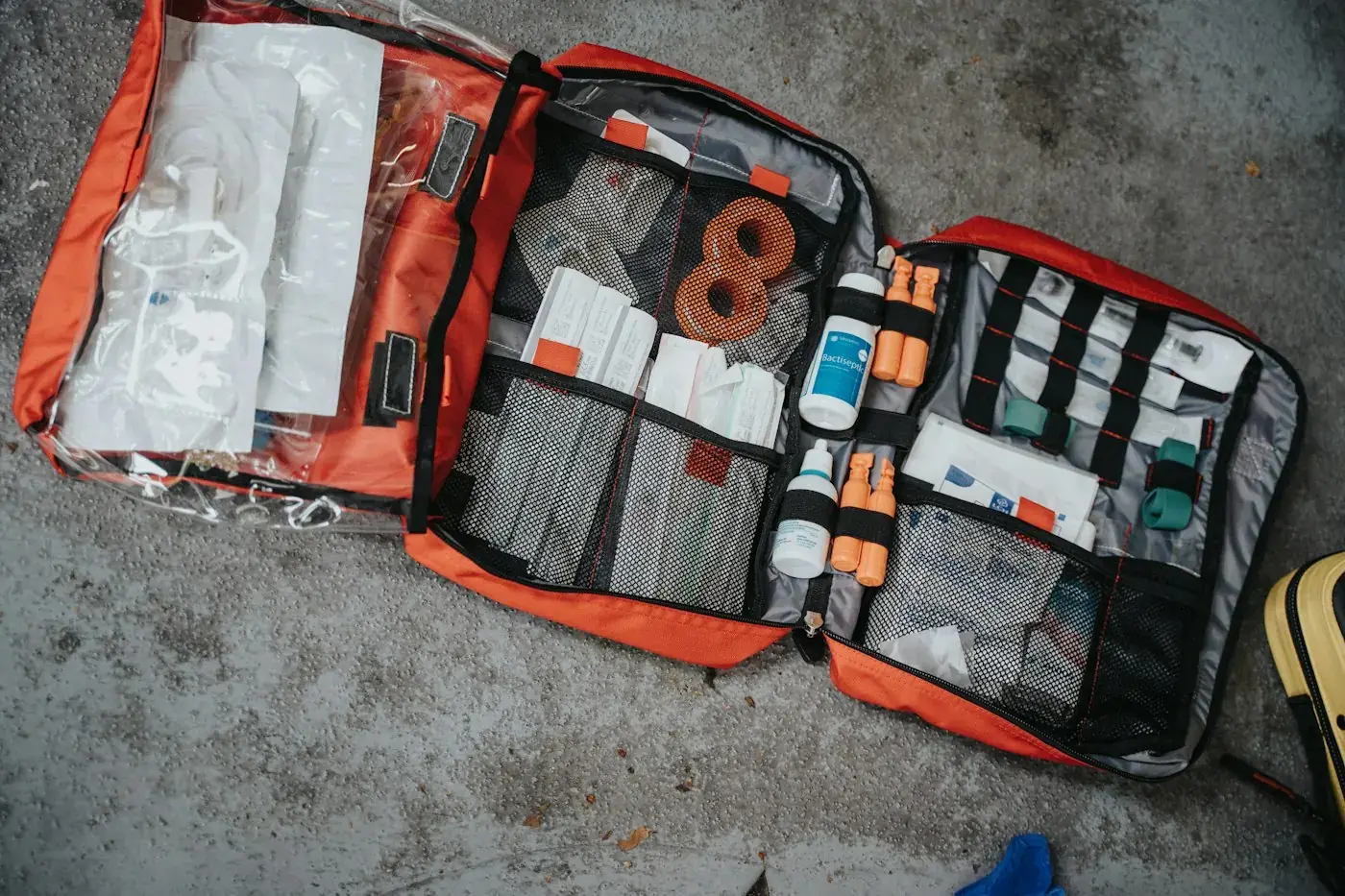
There is no mandatory list. HSE says the contents should be based on your needs assessment. For low-risk work, such as desk-based work, it gives a suggested minimum: a leaflet with general first aid guidance, individually wrapped sterile plasters in assorted sizes, sterile eye pads, individually wrapped triangular bandages, safety pins, large and medium sterile unmedicated wound dressings, and disposable gloves. The quantities in the key facts table above come from L74, Appendix 2.
A few points from HSE’s guidance that people often miss:
- British Standard BS 8599-1 is optional. HSE’s first aid FAQs say a kit doesn’t have to meet it. It can, as long as it matches or exceeds what your assessment found.
- No tablets or medicines. HSE recommends you don’t keep them in the kit. First aid at work doesn’t include giving tablets to treat illness, with one exception: aspirin for a suspected heart attack, in line with accepted first aid practice.
- Mark it clearly. Kits should show a white cross on a green background, be easy to reach and be protected from dust and damp.
- Add what your risks need. L74 gives examples such as foil blankets, haemostatic dressings, tourniquets, disposable aprons, shears and moist wipes. If there’s no mains tap water for washing wounds and eyes, provide at least one litre of sterile water or sterile saline in sealed containers.
- Travelling staff may need their own smaller kit, for which L74 also suggests contents.
How to Check and Restock a First Aid Kit
HSE says to check your kit regularly and restock it soon after use. There’s no set timetable, so pick one that suits how often the kit gets used and stick to it.
- Count each item against your kit list and note anything used or missing.
- Check expiry dates, particularly on sterile items. Replace anything out of date and dispose of it safely.
- If a sterile item has no expiry date, ask the manufacturer how long it can be kept. For non-sterile items without dates, check they’re still fit for purpose.
- Restock, then record the date and your initials on the kit checklist.
This is a natural job for the appointed person, since HSE says their role includes looking after the first aid equipment. The template’s check log gives you a simple record.
How Many First Aiders Do You Need?
HSE says there are no hard and fast rules. It depends on your work and where you do it. L74 does give suggested numbers as a starting point (Appendix 3):
| Hazard level | Employees | Suggested first aid personnel |
|---|---|---|
| Low (offices, shops, libraries) | Fewer than 25 | At least 1 appointed person |
| Low | 25 to 50 | At least 1 first aider trained in EFAW |
| Low | More than 50 | At least 1 FAW-trained first aider for every 100 employed |
| Higher (for example warehousing, food processing, construction) | Fewer than 5 | At least 1 appointed person |
| Higher | 5 to 50 | At least 1 EFAW or FAW first aider, depending on likely injuries |
| Higher | More than 50 | At least 1 FAW-trained first aider for every 50 employed |
These are suggestions only. Adjust them for shifts, holidays, split sites and lone workers, because cover has to be there whenever people are at work. Your risk assessments tell you which hazard level fits.
Photo: Claudio Schwarz on Unsplash
Appointed Person or First Aider?
An appointed person takes charge of first aid arrangements: looking after the kit and facilities and calling the emergency services. HSE says they don’t need any formal training, and that one must be available whenever people are at work. They should not attempt first aid they haven’t been trained for. In a small, low-risk workplace, an appointed person and a stocked kit may be all you need.
A first aider has been trained by a competent provider, usually in emergency first aid at work (EFAW) or first aid at work (FAW). FAW covers everything in EFAW plus a range of specific injuries and illnesses. If your assessment shows higher hazards, such as machinery or hazardous substances, you’re more likely to need first aiders.
Whichever you have, regulation 4 says you must tell employees about the arrangements, including where the kit, facilities and people are. Record incidents properly too: our guides to the accident book and RIDDOR explain what the law requires.
Choosing First Aid Training
We don’t run first aid courses, so here is what HSE says. Since 2013, HSE no longer approves first aid training or training providers (except for offshore work). It’s your responsibility to make sure whoever trains your staff is competent. HSE describes four types of provider:
- regulated qualifications from an awarding organisation, regulated by Ofqual, the SQA or the Welsh Government
- voluntary approval schemes, such as a trade body accredited by a third party like UKAS
- independent training where the provider can prove its competence
- the three Voluntary Aid Societies: St John Ambulance, British Red Cross and St Andrew’s First Aid
HSE’s free guide GEIS3, Selecting a first-aid training provider sets out what a competent provider should be able to show. L74 adds that first aid certificates are valid for three years, and HSE strongly recommends annual refresher training in between.
What to Do Next
This week, download the template and answer the assessment questions with your risk assessments and accident records in front of you. Then check every first aid kit against the checklist, note expiry dates and make sure every employee knows where the kit is and who to call.
First aid is one part of the picture. For managers who need to assess and control the risks behind it, see our health and safety training and the Health and Safety at Work Act guide.